
602-491-2588

Appraisal as Leverage: When It Makes Sense to Escalate

Appraisal has a reputation problem. It gets talked about as the nuclear option, the thing you do when the relationship has broken down and you are ready to fight. That framing costs contractors money, because it turns a procedural tool into an emotional decision.

Appraisal is a dispute-resolution mechanism written into most property policies, because reasonable parties sometimes disagree about the value of a loss. Used appropriately, it creates a credible alternative to accepting the carrier’s position, and that changes a negotiation because both sides know the dispute has another path. It is also one escalation path, not the escalation path.
What the Process Is

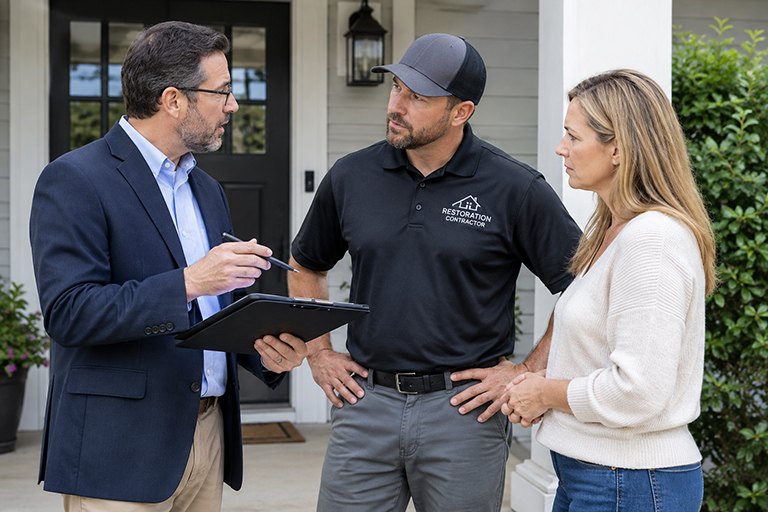
appraisal diiscussionEach side appoints an appraiser, and the two attempt to agree on the amount of loss. Unresolved differences go to a neutral umpire, and the resulting award is generally binding under the applicable appraisal provision. It is intended to resolve the amount of loss rather than coverage, though that boundary varies by state and by dispute, and it does not guarantee any invoice will be paid in full.

Eligibility Is the Gate

Start here, because none of the economics matter if the mechanism never opens.

You cannot assume the option is available. Across demands on our platform, a substantial share never reached an appraiser. Some were rejected by the carrier, others presented eligibility or standing problems from the outset. Those are not the same thing: a carrier declining a demand is a position, not a ruling, and denials can sometimes be overturned by responding to them. Either way the file stalls, and the obstacles are rarely about the merits of the work. They are procedural or contractual: questions about assignment or standing, state restrictions on assignments, or exhausted policy limits.

That reframes your front-end paperwork. Your work authorization and, where applicable, your assignment documentation are more than collection tools. They help establish the contractual foundation you may need if escalation becomes appropriate months later. A file with a clean authorization package has options. A file with gaps in that foundation has far fewer.

What Appraisal Does to the Number

This is where the honest version matters more than the sales version.

Across files that reached an appraisal award in the last two years, the total amount the carrier committed to pay, measured against the original billed invoice, landed at roughly 56 percent at the median. Almost none reached or exceeded the full invoice. If you go into appraisal expecting your invoice back in full, the data does not support that.

What it does support is movement. Measured against the carrier’s pre-appraisal position, meaning the amount it had already acknowledged as payable, more than nine out of ten awarded files ended up higher, at the median around one and a half times that starting point. Appraisal does not make your invoice unquestionable. It moves the valuation to a forum where the carrier’s opening position is not the ceiling.

Roughly one in seven demands also settled after the demand but before any award. The demand itself changes the calculation.

Three Signs a File May Be Worth Escalating

Escalation is not a volume strategy. In our data it concentrates in a specific shape of file.

  • The gap is large in absolute dollars, not just percentage terms. Among files of similar size, those that went to appraisal had roughly twice the unresolved dollar gap. A twenty percent disagreement on a four thousand dollar invoice and the same percentage on a forty thousand dollar invoice are not the same decision.
  • The carrier has acknowledged only a small share of the invoice. On escalated files, the undisputed amount sat meaningfully lower as a share of billed dollars, which can indicate the disagreement extends across the scope or valuation of the work rather than a handful of line items.
  • Negotiation has genuinely stalled, not just slowed. In our files, the demand typically came a little over two months after the invoice was first submitted to us: after a substantive negotiation cycle, not instead of one.

The Arithmetic

The threshold that matters is the disputed gap, not the invoice total. A large invoice the carrier has largely agreed to fund is not an appraisal candidate; a mid-sized invoice with most of it unresolved may well be. Contractors who escalate deliberately set a floor on that gap, often in the low four figures, and hold to it.

Costs are knowable in advance. Each party generally bears its own appraiser, with umpire costs typically shared. Appraiser fees run in the mid hundreds of dollars in our files, and an umpire was needed on only a small minority of awarded files; the two appraisers agree more often than the reputation suggests. Awarded files took about two months from demand to award at the median, most between roughly one month and three and a half.

Run it on a file. Take a twenty thousand dollar invoice where the carrier has acknowledged under eight thousand, leaving a gap above twelve thousand. At the median movement in our awarded files, the final number lands several thousand dollars above where the carrier started, against an appraiser fee in the hundreds. The fee is not the real cost; the two months is. Run the same math on a four thousand dollar invoice with a nine hundred dollar gap and the answer flips before you finish the sentence.

So the question is not whether the invoice is large, but whether the likely movement justifies the fees, the time, and the cost of carrying the receivable while you wait. Timing cuts both ways: escalating early spends money on a conversation that might have closed on its own, while waiting too long adds the appraisal clock to an aging receivable. Decide early what would trigger escalation on a file, so the call gets made on the signals rather than on frustration.

Knowing Which Files Are Worth It

The contractors who use appraisal well are not the ones who use it most. They are the ones who know which files qualify, which are worth the cost, and which carriers tend to move before an award is ever issued.

That pattern recognition is much of what One Claim Solution does: tracking how carriers behave, building the documentation that supports the contractor’s position, and surfacing the arithmetic where escalation looks warranted so the contractor can make the call. For more practical claims insight, subscribe to Claims Corner.

Methodology note: figures are derived from claims processed on the OCS platform, drawn from appraisal demands, settlements following demands, and awards over the trailing two years, with demand outcomes measured on demands old enough to have resolved. An awarded file is one where an appraisal award was issued. Committed amounts are compared to amounts billed on the same invoice. Exact figures are generalized, carriers are not identified, and findings are directional. Nothing here is legal advice; appraisal rights, standing, assignment rules, and the scope of issues considered in appraisal vary by policy and by state.

Connor Trahan

Account Executive

Hi there! I’m Connor, the Account Executive for One Claim. My goal is to guide our contractors through the sales process, ensuring you’re equipped with all the information you need to make your decision and hit the ground running once aboard. We view ourselves as an extension of your business and I strive to make the process an enlightening and consultative one.
My career has primarily been focused in software sales over a few different industries but the last few years were spent helping general contractors solve similar problems to what we’re doing here at OCS! Outside of work, I love spending time with my family, cooking and boating during the summer months.

Nicole Liesenfelt

Director, Human Resources

Hello! I’m Nicole, and I’m here to champion for our employees, recruit for new talent, and impact culture at One Claim Solution. I find satisfaction in supporting a memorable employee experience and bring innovation, problem solving, and strategic view to the process. Nothing is more important than our people, and a healthy culture is my top priority! I have had the pleasure of building my career in various sectors, specializing in small to medium size firms focused on high-growth. My experience is centered around driving and implementing change, leading high-performing teams, and driving process improvements. I am excited to make an impact at One Claim. Outside of work, my family and I enjoy getting outdoors as much as possible to explore beautiful Colorado!

Elizabeth McGlone

Demand Generation Manager

Great to meet you! I’m Elizabeth, and I’m the one behind all the emails and advertisements you’ve been seeing. As the Demand Generation Manager at One Claim Solution, my mission is to connect with contractors like you who need our services. I’m passionate about having an impact on others and I bring a wealth of experience in demand generation and marketing strategy to create moments of delight, curiosity, and education for you.

Prior to One Claim Solution, I had the privilege of building marketing departments from the ground up at companies in a variety of industries, including IT consulting, first protection, and healthcare. Personally, I love being outdoors, playing Dungeons and Dragons and board games, singing, and traveling.

Alisha Yartzoff

Director of Contractor Success

Welcome! I’m Alisha, and I’m here to champion your success as the Director of Contractor Success at One Claim. With a passion for helping contractors thrive, I bring a wealth of experience in onboarding, customer service, and account management to ensure your journey with us is nothing short of exceptional.

Prior to joining One Claim, I had the privilege of scaling SMB and Enterprise Customer Success teams at fast-growing SaaS startups. With over six years of experience at companies like Mavenlink, Teamwork, and ServiceTitan, I honed my expertise in building high-performing teams and fostering proactive, consultative relationships. This background has equipped me with a deep understanding of the challenges faced by businesses like yours, and I’m dedicated to helping you overcome them.

Eric Terry

CTO

Hi there, my name is Eric! I am the Chief Technology Officer here at OCS, spearheading our technical strategy. I have a background in computer science, graduating cum laude from BYU-Idaho with a Bachelor’s degree in Computer Information Technology.

Before coming to One Claim, I served as the Director of Engineering at Slingshot Technology, Inc., a company later acquired by WorkWave in 2021. My professional journey has spanned both emerging startups and established corporations, with a steadfast focus on cultivating high-trust, low bureaucracy teams and innovating technology using agile methodologies.

In my free time, you can find me flying drones, enjoying the outdoors, and spending time with my family.

Cam Smith

COO

Hello, my name is Cam, I’m the COO of One Claim Solution! I come from a management consulting background (Bain & Company) and hold an MBA from the University of Michigan. I have worked at a wide variety of organizations, from Fortune 500 to small-cap, in an equally wide variety of industries. I have over 15 years of experience in operations and strategic growth, and I have spent much of my career focused on developing high-performing tech-enabled service organizations through early stage and high growth phases.

Outside of work, my wife Brittny and I have four kids, ages 13 to 6. As residents of Mesa, Arizona, we love to ski and explore the national parks of the southwest!

Dan Doud

CEO

Hello, my name is Dan, and I am the CEO of One Claim Solution. I am super excited by everything we are doing at OCS to be the market leading insurance billing specialist that advocates on behalf of our restoration contractors. 

My professional experiences are predominantly corporate in nature. My career started at General Electric in finance and accounting. Immediately prior to joining OCS, I spent time as an investor at Bondcliff Partners and management consultant with Bain & Company. I also hold an MBA from the Kellogg School of Management at Northwestern University and got my BS in finance and accounting from Northeastern University.

Outside of the office, I enjoy spending time with my wife, two young children, and our family dog, Whiskey. We live in Charleston, SC and take advantage of the beautiful weather by spending as much time as possible outside at the beach or adventuring around town

Josh Ehmke

Co-Founder and General Counsel

Hi, I’m Josh! In 2016, I co-founded One Claim Solution with my partner Jeremy Traasdahl, and I serve as General Counsel of One Claim Solution. Working in the restoration industry, Jeremy and I saw contractors struggling to get paid quickly and fairly and we knew there was a need for change. We founded One Claim Solution to be this change and it’s been my privilege to see our company grow and to advocate for our clients as general counsel.

Outside of my passion for helping the restoration industry, I enjoy spending time outdoors, fly-fishing, hunting, skiing, and coaching my kids’ baseball teams. I’ve been married to my amazing wife for 20 years and we have a beautiful family of 5 children.

Jeremy Traasdahl

Co-Founder

Hey, I’m Jeremy! In 2016, I co-founded One Claim Solution with my partner Josh Ehmke. Working in the restoration industry, Josh and I saw contractors struggling to get paid quickly and fairly and we knew there was a need for change. We founded One Claim Solution to be this change and it’s been my privilege to lead our amazing team.

Prior to One Claim Solution, I started my career as an inside sales rep for Avnet, then moved to Pepsico as a district sales manager. Outside of work, I love spending time with my wife and four children, two boys and two girls!